
Exposición Individual Septiembre – Octubre 2017: Eugenio Pardini in Marbella
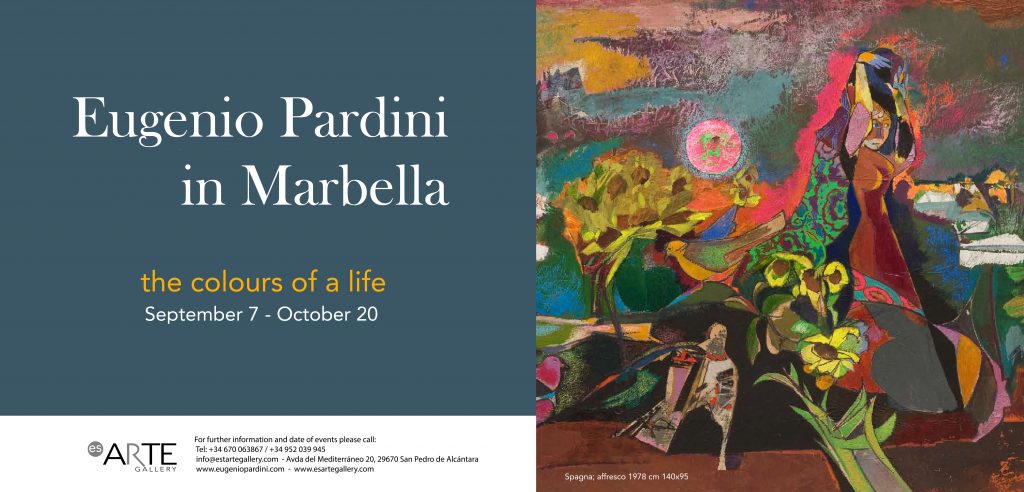
[vc_row][vc_column][vc_single_image image=”987″ img_size=”full” alignment=”center” onclick=”link_image”][/vc_column][/vc_row][vc_row][vc_column][vc_single_image image=”1086″ img_size=”full” alignment=”center” onclick=”link_image”][/vc_column][/vc_row][vc_row][vc_column][vc_message]Exposición: Eugenio Pardini in Marbella. Fecha: Del 07 de septiembre 2017 al 20 de octubre 2017. Evento inauguración: 07 de septiembre 2017 a las 19:00. Lugar: Es.Arte Gallery Marbella.[/vc_message][/vc_column][/vc_row][vc_row][vc_column][vc_column_text]Sean Hepburn en colaboración con Es.Arte Gallery presenta la colección del artista italiano Eugenio Pardini en Marbella. Marbella acogerá la obra del pintor Eugenio Pardini (1912-2003). Las piezas que pertenecen a la colección privada de Sean Hepburn Ferrer se ubicarán en cuatro espacios expositivos en Marbella, Es.Arte Gallery, FM, Hotel Puente Romano y La Zagaleta.[/vc_column_text][/vc_column][/vc_row][vc_row][vc_column width=”1/4″][vc_single_image image=”995″ img_size=”large” alignment=”center” onclick=”link_image”][/vc_column][vc_column width=”3/4″][vc_column_text]Sean Hepburn nos trae la colección del artista italiano Eugenio Pardini a Marbella, ciudad a la cual se siente especialmente conectado ya que pasó largos veranos de su infancia en la casa que sus padres (Audrey Hepburn y Mel Ferrer) tenían en el Marbella Club. Conocedor de la cultura y del idioma, apuesta por el sur de España para esta gran exposición que inicialmente se presentó en Caja Granada y ahora en Marbella, ciudad cosmopolita de gran exclusividad. Además, la atracción que el artista italiano sentía por Andalucía, tan evidente en sus obras de paisajes llenos de girasoles y la serie taurina, fueron también un factor añadido que impulsó al coleccionista a trasladar la obra a España.[/vc_column_text][/vc_column][/vc_row][vc_row][vc_column width=”1/4″][vc_single_image image=”990″ img_size=”full” alignment=”center” onclick=”link_image”][/vc_column][vc_column width=”3/4″][vc_column_text]El Sr. Hepburn se enamoró de la obra de Pardini en una visita a la casa del autor, en la Toscana Italiana, desde entonces se hizo con la mayor parte de sus piezas (3.000 obras) convirtiéndose así en el artista más destacado de su colección privada. La muestra tiene carácter retrospectivo, recogiendo distintas etapas con variedad de ejemplos tanto estilísticos, temáticos como técnicos. Su obra se envuelve en un prodigioso colorido auspiciado siempre por un dibujo claro y directo, un lenguaje onírico donde la mitología clásica, la fecundidad encarnada por los frutos de la naturaleza y la maternidad, la belleza y la vitalidad en esencia, no quedan exentas de refinamiento y sutileza.[/vc_column_text][/vc_column][/vc_row][vc_row][vc_column][vc_column_text]Eugenio Pardini es un artista libre, que a pesar de la clara influencia de la época denota una lírica creativa que deriva en una investigación llena de espontaneidad. Su sentido de la composición y el uso del collage le otorga un estilo muy actual. En 1943 participó en la Quadrienalle di Roma y en 1948 en la XXIV Bienal de Venecia, la primera celebrada tras la Segunda Guerra Mundial y a la que volvería en las ediciones XXV y XXVIII. A lo largo de su vida fue ganador de importantes premios de pintura. MARIO De MICHELI (crítico de arte de la vanguardia Italiana): “(…) Y es, pues, en el último Pardini, el que podemos contemplar en esta exposición: brillante en su uso del color, relajado en su composición, lírico en su amistad con la inspiración.” Debido a la magnitud de la colección la muestra no se reduce a un solo espacio y de este modo, se quiere brindar a la ciudad un nuevo concepto de exposición. Los espacios elegidos son claves para el desarrollo de esta exposición.[/vc_column_text][/vc_column][/vc_row][vc_row][vc_column][vc_single_image image=”992″ img_size=”full” alignment=”center” onclick=”link_image”][/vc_column][/vc_row][vc_row][vc_column][vc_column_text]El 7 de septiembre a las 19.00 horas, tendrá lugar la presentación de la exposición del pintor italiano Eugenio Pardini en Es.Arte Gallery de Marifé Núñez (Avenida del Mediterráneo, 20. San Pedro Alcántara) desde donde se gestionarán las demás exposiciones con ventas limitadas/exclusivas. El 8 de septiembre se presentará a la prensa la obras de grandes dimensiones en el Centro Comercial Fernando Moreno, seguidamente a las 19:30 se inaugurará en el Hotel Puente Romano. Y, finalmente, el 13 de septiembre Sean Hepburn presentará esta novedosa exposición cargada de magia mediterránea en el Club Social de la exclusiva Urbanización La Zagaleta. Un recorrido antológico de la obra de Eugenio Pardini en Marbella.[/vc_column_text][/vc_column][/vc_row][vc_row][vc_column][vc_column_text] Momentos de la exposición de Eugenio Pardini [/vc_column_text][/vc_column][/vc_row][vc_row][vc_column][vc_media_grid element_width=”3″ grid_id=”vc_gid:1519471565542-3e67ce87-2978-4″ include=”1262,1261,1260,1259,1258,1257,1409″][/vc_column][/vc_row][vc_row][vc_column][vc_column_text] La obra de Eugenio Pardini discurre como un tratado de valores tradicionales entre el contorno y la figura junto a un soberbio color. Desde sus comienzos ya se aprecia una frontera entre el espacio y la figura, condicionada por unos de los términos más usado en pintura: Il trattamento. Si se aprende a dominar esa frontera, o dicho de otra manera, a entender la estilización del lenguaje plástico en determinados contextos comprendemos su tendencia, además, de la conclusión del hecho pictórico y de su iconicidad, de esta manera asimilamos la pintura de Pardini en toda su extensión. La percepción en la categoría enunciada es una simple variable de posibilidades que demuestra la capacidad creativa a través de rangos estéticos. Pues es aquí donde el artista decide su trayectoria, que puede ir acotando o extendiendo según esas variables de las que hemos hablado, sin programar en profundidad hasta qué punto puede acotar lo aprendido y convivir con su proteica creatividad. Pardini no es una excepción, su permeabilidad es muy clara y su evolución se detecta en el trazo, como el elemento intermitente de las vanguardias figurativas, donde todos los componentes pictóricos de un reciente pasado pasan a ser indispensables y se convierten en una bisagra entre tendencias reconocidas, sin dar tregua a esa luz que el mismo Fatori firmaría como una luz del mediodía incandescente que se va tornando en una paleta despiadada con una textura superficial, instigadora, voraz e inquietante que provoca una profundidad lumínica como si se tratara de un discípulo de Turner o un acercamiento al mismísimo Bernardo Daddi, donde el color firma una de sus mejores etapas. Dejando por un momento el análisis cromático en la obra de Eugenio Pardini, su trayectoria se dirige hacia un lenguaje puramente organicista, lo que automáticamente fija la atención en el movimiento, una combinación entre la cromaticidad y la acción que se podría incluso argumentar como un discurso continuista del surrealismo de Roberto Matta, marcado por la desintegración paulatina de la figura, que curiosamente invierte, cuando el desarrollo suele ser al contrario, de la experimentación se vuelve al orden y así sucesivamente. No cabe duda que Eugenio Pardini fue un ferviente admirador de las pre-vanguardias y, por otro lado,
Exhibition September – October 2017: Eugenio Pardini in Marbella
[vc_row][vc_column][vc_single_image image=”987″ img_size=”full” alignment=”center” onclick=”link_image”][/vc_column][/vc_row][vc_row][vc_column][vc_single_image image=”11351″ img_size=”full” alignment=”center” onclick=”link_image”][/vc_column][/vc_row][vc_row][vc_column][vc_message]Exhibition: Eugenio Pardini in Marbella. Date: Del 07 de septiembre 2017 al 20 de octubre 2017. Inaguration: 07 de septiembre 2017 a las 19:00. Place: Es.Arte Gallery Marbella.[/vc_message][/vc_column][/vc_row][vc_row][vc_column][vc_column_text]Sean Hepburn in collaboration with Es.Arte Gallery presents the collection of the Italian artist Eugenio Pardini in Marbella. Marbella will host the work of the painter Eugenio Pardini (1912-2003). The pieces that belong to the private collection of Sean Hepburn Ferrer will be located in four exhibition spaces in Marbella, Es.Arte Gallery, FM, Hotel Puente Romano and La Zagaleta.[/vc_column_text][/vc_column][/vc_row][vc_row][vc_column width=”1/4″][vc_single_image image=”11353″ img_size=”large” alignment=”center” onclick=”link_image”][/vc_column][vc_column width=”3/4″][vc_column_text]Sean Hepburn brings the collection of the Italian artist Eugenio Pardini to Marbella, a city to which he feels especially connected since he spent long summers of his childhood in the house that his parents (Audrey Hepburn and Mel Ferrer) had in Marbella Club. Knowing the culture and the language, he bets on the south of Spain for this great exhibition that was initially presented in Caja Granada and now in Marbella, a cosmopolitan city of great exclusivity. In addition, the attraction that the Italian artist felt for Andalusia, so evident in his works of landscapes full of sunflowers and the bullfighting series, were also an added factor that prompted the collector to move the work to Spain.[/vc_column_text][/vc_column][/vc_row][vc_row][vc_column width=”1/4″][vc_single_image image=”11357″ img_size=”full” alignment=”center” onclick=”link_image”][/vc_column][vc_column width=”3/4″][vc_column_text]Mr. Hepburn fell in love with Pardini’s work during a visit to the author’s home in Italian Tuscany. Since then, he has acquired most of his pieces (3,000 works), becoming the most outstanding artist in his private collection. The exhibition has a retrospective character, gathering different stages with a variety of stylistic, thematic and technical examples. His work is enveloped in a prodigious colorfulness always sponsored by a clear and direct drawing, an oniric language where classic mythology, fertility embodied by the fruits of nature and motherhood, beauty and vitality in essence, are not exempt from refinement and subtlety.[/vc_column_text][/vc_column][/vc_row][vc_row][vc_column][vc_column_text]Eugenio Pardini is a free artist, who in spite of the clear influence of the time denotes a creative lyric that leads to an investigation full of spontaneity. His sense of composition and the use of collage give him a very up-to-date style. In 1943 he participated in the Quadrienalle di Roma and in 1948 in the XXIV Venice Biennale, the first one held after the Second World War and to which he would return in the XXV and XXVIII editions. Throughout his life he was the winner of important painting awards. MARIO De MICHELI (art critic of the Italian avant-garde): “(…) And it is, therefore, in the last Pardini, that we can contemplate in this exhibition: brilliant in his use of color, relaxed in his composition, lyrical in his friendship with inspiration”. Due to the magnitude of the collection, the exhibition is not reduced to a single space and in this way, we want to offer the city a new concept of exhibition. The spaces chosen are key to the development of this exhibition.[/vc_column_text][/vc_column][/vc_row][vc_row][vc_column][vc_single_image image=”11355″ img_size=”full” alignment=”center” onclick=”link_image”][/vc_column][/vc_row][vc_row][vc_column][vc_column_text]On September 7 at 19.00 hours, there will be a presentation of the exhibition of the Italian painter Eugenio Pardini in Es.Arte Gallery of Marifé Núñez (Avenida del Mediterráneo, 20. San Pedro Alcántara) from where the other exhibitions will be managed with limited/exclusive sales. The 8 of September will be presented to the press the works of great dimensions in the Mall Fernando Moreno, next to 19:30 will be inaugurated in the Hotel Puente Romano. And, finally, on September 13 Sean Hepburn will present this novel exhibition loaded with Mediterranean magic in the Social Club of the exclusive Urbanization La Zagaleta. An anthological tour of the work of Eugenio Pardini in Marbella.[/vc_column_text][/vc_column][/vc_row][vc_row][vc_column][vc_column_text] Eugenio Pardini’s Exhibition Moments [/vc_column_text][/vc_column][/vc_row][vc_row][vc_column][vc_media_grid element_width=”3″ grid_id=”vc_gid:1519471565542-3e67ce87-2978-4″ include=”1262,1261,1260,1259,1258,1257,1409″][/vc_column][/vc_row][vc_row][vc_column][vc_column_text]Eugenio Pardini’s work runs like a treatise of traditional values between the outline and the figure together with a superb color. From the beginning, a border between space and figure can be seen, conditioned by one of the most used terms in painting: Il trattamento. If one learns to master this frontier, or in other words, to understand the stylization of the plastic language in certain contexts, we understand its tendency, besides the conclusion of the pictorial fact and its iconicity, in this way we assimilate Pardini’s painting in all its extension. The perception in the enunciated category is a simple variable of possibilities that demonstrates the creative capacity through aesthetic ranges. It is here where the artist decides his trajectory, which can be limited or extended according to those variables we have talked about, without programming in depth up to what point he can limit what he has learned and live with his protean creativity. Pardini is not an exception, his permeability is very clear and his evolution can be detected in the line, as the intermittent element of the figurative avant-garde, where all the pictorial components of a recent past become indispensable and become a hinge between recognized trends, without giving truce to that light that Fatori himself would sign as an incandescent midday light that turns into a merciless palette with a superficial, instigating, voracious and disturbing texture that provokes a luminous depth as if it were a Turner disciple or an approach to Bernardo Daddi himself, where color signs one of its best stages. Leaving for a moment the chromatic analysis in Eugenio Pardini’s work, his trajectory is directed towards a purely organicist language, which automatically fixes the attention on movement, a combination between chromaticity and action that could even be argued as a continuation of Roberto Matta’s surrealism, marked by the gradual disintegration of the figure, which curiously reverses, when the development is usually the opposite, from experimentation to order and so on. There is no doubt that Eugenio Pardini was a fervent admirer of the pre-avant-gardes and, on the other hand, of the avant-gardes he knew how to extract the qualities of the movement as a reason for being of the French colorists who added a primitivism, not only to the figures but to the conscience.