
NUEVA ABSTRACCIÓN POST-PICTÓRICA
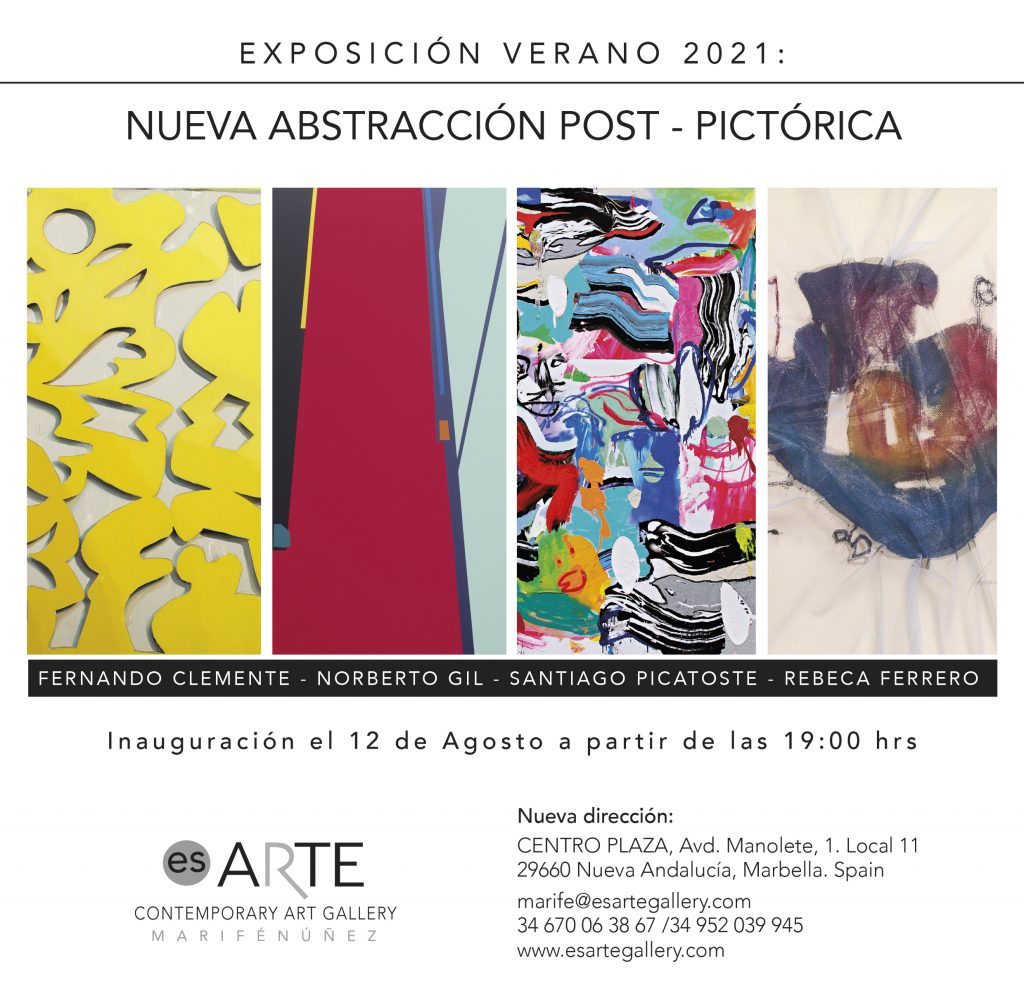
[vc_row][vc_column width=”1/2″][vc_single_image image=”15384″ img_size=”medium” alignment=”center”][vc_empty_space height=”10px”][vc_btn title=”NORBERTO GIL” style=”outline” shape=”square” color=”black” size=”sm” align=”center” button_block=”true” link=”url:https%3A%2F%2Fesartegallery.com%2Fnorberto-gil|title:Norberto%20Gil||”][/vc_column][vc_column width=”1/2″][vc_single_image image=”15386″ img_size=”medium” alignment=”center”][vc_empty_space height=”10px”][vc_btn title=”REBECA FERRERO” style=”outline” shape=”square” color=”black” size=”sm” align=”center” button_block=”true” link=”url:https%3A%2F%2Fesartegallery.com%2Frebeca-ferrero|title:Rebeca%20Ferrero||”][/vc_column][/vc_row][vc_row][vc_column width=”1/2″][vc_single_image image=”15382″ img_size=”medium” alignment=”center”][vc_empty_space height=”10px”][vc_btn title=”FERNANDO CLEMENTE” style=”outline” shape=”square” color=”black” size=”sm” align=”center” button_block=”true” link=”url:https%3A%2F%2Fesartegallery.com%2Ffernando-clemente|title:Fernando%20Clemente||”][/vc_column][vc_column width=”1/2″][vc_single_image image=”15388″ img_size=”medium” alignment=”center”][vc_empty_space height=”10px”][vc_btn title=”SANTIAGO PICATOSTE” style=”outline” shape=”square” color=”black” size=”sm” align=”center” button_block=”true” link=”url:https%3A%2F%2Fesartegallery.com%2Fartistas%2Fsantiago-picatoste|title:Santiago%20Picatoste||”][/vc_column][vc_column][vc_single_image image=”10955″ img_size=”medium” alignment=”center” title=”Jorge Hernández”][vc_empty_space][vc_btn title=”Jorge Hernández” style=”outline” shape=”square” color=”black” size=”sm” align=”center” link=”url:https%3A%2F%2Fesartegallery.com%2Fjorge-hernandez|title:Jorge%20Hern%C3%A1ndez||”][/vc_column][/vc_row][vc_row][vc_column][vc_column_text] NUEVA ABSTRACCIÓN POST-PICTÓRICA Fernando Clemente – Norberto Gil – Santiago Picatoste – Rebeca Ferrero Los fundamentos del símbolo Patricia Bueno del Río Hacia 1940, Barnett Newman se preguntaba para qué pintar, posiblemente porque en su tiempo, lo conceptual se abría paso dando lugar a un mundo en el que cada vez cobraba más importancia la hegemonía del pensamiento. “Todo tiene una forma, y toda forma tiene un significado”, sugería por su parte con cordura Josef Albers, consciente de que en la creación, no existía desmérito o apocamiento por el hecho de enaltecer el color y la materia como razón única de su existencia cuando de pintar se trataba. Ofrecer una imagen deconstruida, personal y subjetiva del mundo, se antoja hoy como la manera más romántica de crear una imagen verosímil, simplemente, por el valor de cimentar pensamiento y por el atrevimiento de mostrarlo en un mundo en el que prevalecen los mensajes directos. Es por esto que las distintas formas en que los artistas se enfrentan a la creación de formas abstractas son misterios que no atienden a un raciocinio metódico, tal vez, porque en la acción de despojarse de la carga – la matérica y la conceptual a veces – se deja solo descubierto la intencionalidad del que crea, esto es, la verdad del pintor que pinta, su sentido de la estética y su dominio de la técnica, cuestiones, que actualmente no son elogiadas, pero sí veraces pues, en el saco del hedonismo ¿quien está libre de carga para poder tirar la primera piedra? . En el caso de los artistas que constituyen la muestra, esta forma de pensamiento parece ajustarse a sus metodologías de trabajo, haciendo uso de formas abstraídas simples que aparecen combinadas en composiciones personales sobre espacios que son casi siempre irreales. Así ocurre en la obra de Fernando Clemente (Jerez de la Frontera, Cádiz, 1975) un artista con una pintura intimista y emotiva que tiende hacia una abstracción particular. En su última etapa, Clemente ha investigado acerca de las cualidades físicas de la creación pictórica, del objeto, y ha enriquecido su lenguaje artístico con derivas que persiguen analogías formales entre la composición plástica y la musical, en la que se percibe el ritmo, el color y la línea como componentes equidistantes. Sus creaciones, son un alarde de entusiasmo, un sentimiento difícil de racionalizar, que despierta la explosión creativa. Su geometría sitúa al espectador, mientras que el color lo envuelve. Pero a su vez, utiliza recursos de maestría que lo avalan como pintor de método, como son los resaltes, las sombras y solapamientos y denota la existencia de cierta nostalgia por lo primitivo, por la pureza. Norberto Gil (Sevilla, 1975), por su parte, lleva a cabo una abstracción que parte de una idea pre establecida. En sus obras, se adivinan formas que remiten a la arquitectura o a elementos de ella, a través del uso de colores ácidos, composiciones estudiadas y factura impoluta. Contemplar sus creaciones, obliga a discernir sobre la depuración de las formas, que llegan a reducirse hasta sus componentes fundamentales: líneas, planos y cubos. Estructuralmente, presenta una armonía apabullante, a través de su estudiado trabajo previo de proporción y composición, con lo que obtiene como resultado una pintura de gran equilibrio entre geometría y el color. De ahí que sus obras sean básicamente constructivas, aunque logren tirar de la mirada, estimular la memoria e impulsar el pensamiento. En cuanto al trabajo de Santiago Picatoste (Palma de Mallorca, 1971) con una amplia trayectoria, merece resaltar su capacidad evolutiva pues, se trata de un artista que compagina su fortísima personalidad con una constante vocación investigadora y una gran capacidad evolutiva, lo que lo ha llevado a pasar por distintas etapas, encontrándose ahora en un momento de síntesis en el que amalgama su reconocido estilo abstracto con cierta reminiscencia al mundo del Cómic. Picatoste crea, ahora como antes, teniendo presente la espontaneidad, y la alquimia en el proceso creativo, pero su idea plástica se torna cada vez más expresionista. Sus últimas creaciones cuentan con un material innovador y ecofriendly, el acetato polivinílico, que usa como aglutinante para su pigmento y que está creado a través de plásticos reciclados obtenidos de los océanos. Por otra parte, su estilo cosmopolita que contrasta con el uso sistemático que hace del instintivo gesto, lo conecta con los estilos de la vanguardia americana del siglo XX y enlaza con la premisa que lo vincula a sus otros compañeros de cartel, la reducción conceptual hacia lo fundamental de su trabajo, o como dicen en el gremio: uniéndolo a la órbita de la “pintura pintura”. Por último, Rebeca Ferrero (Béjar, Salamanca, 1990), una artista joven cuya creatividad le da cobertura suficiente como para ser el cuarto bastión de la muestra. Su obra, abstracta e innovadora combina su capacidad plástica con el riesgo que deriva del uso personal de la técnica que emplea, pues, a partir del grabado, crea composiciones genuinas que se basan en la superposición de diversas telas tratadas, lo que dan como resultado una obra única y subjetiva, con base en el género del paisaje. Las escenas que resultan son sugerentes y atrayentes; evanescentes, lo que hace al espectador sumergirse en una especie de episodio onírico que le invita a pensar y sentir. Su originalidad radica, además de en el uso innovador de la técnica, en la selección de los materiales, – las telas – que superpone, combina y manipula para concretar la forma, más allá del simple soporte. Un uso que recuerda, en esencia, a la mítica frase de Louise Bourgeois: “Tejer como forma de sanar”. En definitiva, un elenco heterogéneo y excelso, que hacen uso de la ambigüedad semántica para proyectar un enigma para
NEW POST-PICTORIAL ABSTRACTION
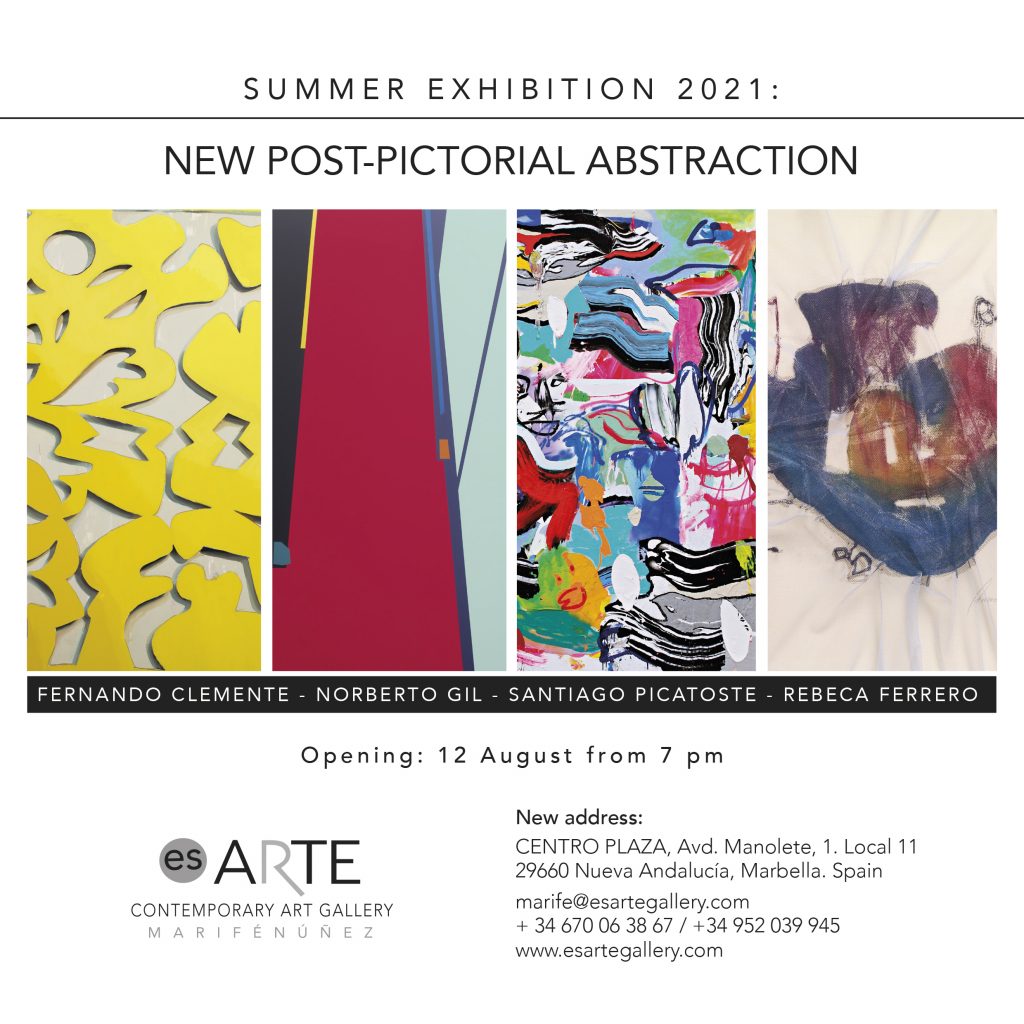
[vc_row][vc_column width=”1/2″][vc_single_image image=”15385″ img_size=”medium” alignment=”center”][vc_empty_space height=”10px”][vc_btn title=”NORBERTO GIL” style=”outline” shape=”square” color=”black” size=”sm” align=”center” button_block=”true” link=”url:https%3A%2F%2Fesartegallery.com%2Fen%2Fnew-post-pictorial-abstraction%2Fnorberto-gil-2|title:Norberto%20Gil|”][/vc_column][vc_column width=”1/2″][vc_single_image image=”15387″ img_size=”medium” alignment=”center”][vc_empty_space height=”10px”][vc_btn title=”REBECA FERRERO” style=”outline” shape=”square” color=”black” size=”sm” align=”center” button_block=”true” link=”url:https%3A%2F%2Fesartegallery.com%2Fen%2Fartists%2Frebeca-ferrero%2Frebeca-ferrero-2|title:Rebeca%20Ferrero|”][/vc_column][/vc_row][vc_row][vc_column width=”1/2″][vc_single_image image=”15383″ img_size=”medium” alignment=”center”][vc_empty_space height=”10px”][vc_btn title=”FERNANDO CLEMENTE” style=”outline” shape=”square” color=”black” size=”sm” align=”center” button_block=”true” link=”url:https%3A%2F%2Fesartegallery.com%2Fen%2Ffernando-clemente|title:Fernando%20Clemente|”][/vc_column][vc_column width=”1/2″][vc_single_image image=”15389″ img_size=”medium” alignment=”center”][vc_empty_space height=”10px”][vc_btn title=”SANTIAGO PICATOSTE” style=”outline” shape=”square” color=”black” size=”sm” align=”center” button_block=”true” link=”url:https%3A%2F%2Fesartegallery.com%2Fen%2Fsantiago-picatoste-3|title:Santiago%20Picatoste|”][/vc_column][vc_column][vc_single_image image=”10956″ img_size=”medium” alignment=”center” title=”Jorge Hernández”][vc_empty_space][vc_btn title=”Jorge Hernández” style=”outline” shape=”square” color=”black” size=”sm” align=”center” link=”url:https%3A%2F%2Fesartegallery.com%2Fen%2Fjorge-hernandez|title:Jorge%20Hern%C3%A1ndez|”][/vc_column][/vc_row][vc_row][vc_column][vc_column_text] NEW POST-PICTORIAL ABSTRACTION Fernando Clemente – Norberto Gil – Santiago Picatoste – Rebeca Ferrero The foundations of the symbol Patricia Bueno del Río Around 1940, Barnett Newman asked himself why paint, possibly because in his time, the conceptual was making its way into a world in which the hegemony of thought was becoming increasingly important. “Everything has a form, and every form has a meaning”, suggested Josef Albers, aware that in creation there was no merit or apocryphalism in exalting colour and matter as the sole reason for its existence when it came to painting. Offering a deconstructed, personal and subjective image of the world seems today to be the most romantic way of creating a plausible image, simply for the value of cementing thought and for the audacity of showing it in a world in which direct messages prevail. This is why the different ways in which artists confront the creation of abstract forms are mysteries that do not attend to methodical reasoning, perhaps because in the action of stripping away the burden – the material and sometimes the conceptual – only the intentionality of the one who creates is left uncovered, that is, the truth of the painter who paints, his sense of aesthetics and his mastery of technique, questions which are not currently praised, but which are true because, in the sack of hedonism, who is unburdened enough to be able to cast the first stone? . In the case of the artists in the exhibition, this way of thinking seems to fit in with their working methodologies, making use of simple abstracted forms that appear combined in personal compositions on spaces that are almost always unreal. This is the case in the work of Fernando Clemente (Jerez de la Frontera, Cádiz, 1975), an artist with an intimate and emotive painting that tends towards a particular abstraction. In his latest stage, Clemente has investigated the physical qualities of pictorial creation, of the object, and has enriched his artistic language with drifts that pursue formal analogies between plastic and musical composition, in which rhythm, colour and line are perceived as equidistant components. His creations are a display of enthusiasm, a feeling difficult to rationalise, which awakens the creative explosion. His geometry situates the spectator, while colour envelops him. But at the same time, he uses masterly resources that endorse him as a painter of method, such as highlights, shadows and overlaps, and denotes the existence of a certain nostalgia for the primitive, for purity. Norberto Gil (Seville, 1975), on the other hand, carries out an abstraction that starts from a pre-established idea. In his works, one can guess forms that refer to architecture or elements of it, through the use of acid colours, studied compositions and a flawless workmanship. Contemplating his creations, one is forced to discern the purification of the forms, which are reduced to their fundamental components: lines, planes and cubes. Structurally, he presents an overwhelming harmony, through his studied previous work of proportion and composition, with which he obtains as a result a painting of great balance between geometry and colour. This is why his works are basically constructive, even though they manage to stimulate the eye, stimulate the memory and stimulate thought. As for the work of Santiago Picatoste (Palma de Mallorca, 1971), it goes without saying how long he has been pursuing his career and highlighting his capacity to evolve, since he is an artist who combines his very strong personality with a constant vocation for research and a great capacity to evolve, which has led him to go through different stages, now finding himself at a moment of synthesis in which he amalgamates his recognised abstract style with a certain reminiscence of the world of Comic strips. Picatoste creates, now as before, keeping in mind the spontaneity and alchemy in the creative process, but his plastic idea becomes more and more expressionist. His latest creations use an innovative and eco-friendly material, polyvinyl acetate, which he uses as a binder for his pigment and which is created from recycled plastics obtained from the oceans. Moreover, his cosmopolitan style, which contrasts with his systematic use of instinctive gesture, connects him to the styles of the 20th century American avant-garde and links him to the premise that links him to his other poster partners, the conceptual reduction to the fundamentals of his work, or as they say in the guild: linking it to the orbit of “painting”. Finally, Rebeca Ferrero (Béjar, Salamanca, 1990), a young artist whose creativity gives her enough coverage to be the fourth bastion of the show. Her work, abstract and innovative, combines her plastic capacity with the risk derived from the personal use of the technique she employs, since, from engraving, she creates genuine compositions based on the superimposition of various treated canvases, resulting in a unique and subjective work, based on the genre of landscape. The resulting scenes are suggestive and attractive; evanescent, which makes the spectator immerse himself in a kind of dreamlike episode that invites him to think and feel. His originality lies not only in the innovative use of technique, but also in the selection of materials – the canvases – which he superimposes, combines and manipulates in order to make the form more concrete, beyond the simple support. A use that recalls, in essence, Louise Bourgeois’ mythical phrase: “Weaving as a way of healing”. In short, a heterogeneous and sublime cast, who make use of semantic ambiguity to project an enigma for the spectator’s gaze, who is challenged and acts between the desire to see and