
COMING BACK TO EARTH
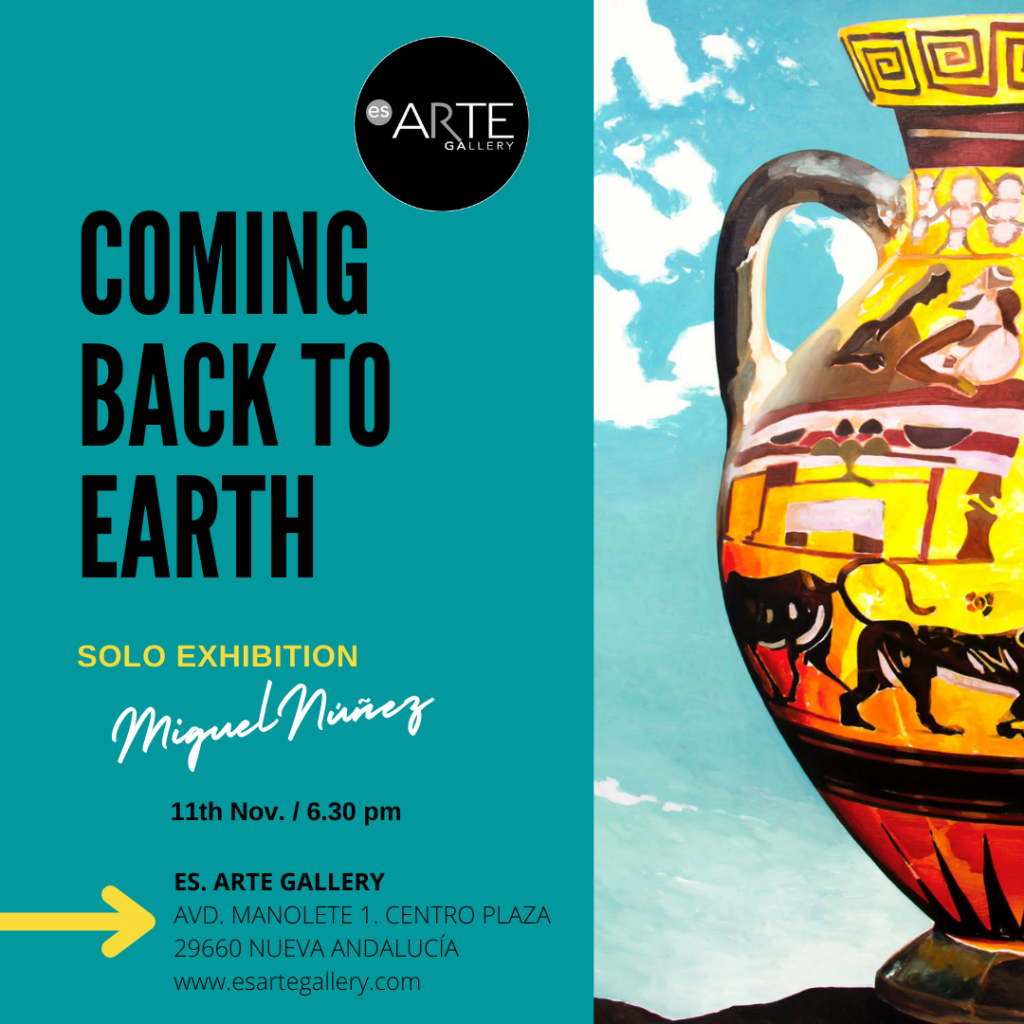
[vc_row][vc_column][vc_single_image image=”16550″ img_size=”medium” alignment=”center”][vc_empty_space height=”10px”][vc_btn title=”MIGUEL NÚÑEZ” style=”outline” shape=”square” color=”black” align=”center” link=”url:https%3A%2F%2Fesartegallery.com%2Fen%2Fartists%2Fmiguel-nunez%2Fmiguel-nunez-2|title:Miguel%20N%C3%BA%C3%B1ez|”][/vc_column][/vc_row][vc_row][vc_column][vc_column_text] BACK TO EARTH – Miguel Núñez THE PRESAGOSITY Patricia Bueno del Río Returning to the earth as a figurative action involves a kind of fiction, whichever way you look at it. It is legitimate and automatic that we associate with what we assume to be strange a certain aspect of the everyday meaning of our lives, because only in this way do we connect with ideas, with what we apprehend and with the magnificent, the sparkling cocktail that sensitive souls crave. In the imaginary of Miguel Núñez (San Roque, Cádiz, 1991) there is a resounding and idyllic way of looking that goes through the act of linking elements from different environments and composes them visually and intellectually to generate disconcerting and symbolic scenes, full of poetics, in which disparate readings are enclosed; all of them, in a natural, instinctive and figurative key, which makes it oscillate between the disturbing of the metaphysical and a peaceful place of enjoyment, a terrain of action and evidence, that is, using the literary myth of the locus amoenus as an ineffable reality. The idea underlying his work, therefore, derives from a clear premise: freedom, the quintessential human capacity that allows us to act of our own free will, and that by using it, turns his painting into a tasteful and independent creation; reflective, methodical and meaningful, giving it a crucial foundation that places it on a transcendental plane and turns it into a psychological and philosophical work that focuses on the essence and perception of beauty, leaving present the intentionality of making reference to concepts such as apotheosis and melancholy. In the works that make up the exhibition Back to Earth there is mystical silence and an apparent tendency towards an understanding of pain. There is also reflective thought, the action of re-dimensioning the reality that is being shaped, and pulsation. In a way, the themes he deals with allude to certain figurative universes that approach an existential vision, in which the figures represented symbolise concerns, illusions and desires that the author seems to seek to materialise through figures that pose an enigma that allows one to constitute oneself towards the construction of one’s own history. In this way, the habitual presence of decontextualised classical sculptures that recall past times, speak to us of our own dreams that are sometimes tinged with the sweetness of decadence by presenting in their constitution, subtle elements of mutilation and deterioration that symbolise the passage of time and absence, and leads us to perceive sensorial phenomena such as silence through visualisation, reminding us of subversive aesthetic theories such as those reflected in the Marquis de Sade’s writings on aesthetics, where it is indicated that the undermining and the voracious is also beauty. [1] The work of this artist reconstructs, in short, a subjective scenography in which the human figure tends to become an icon through art itself, as it appears represented through creations that refer to the intentionality of exaltation. The use of intense, vivid and saturated colours, in contrast with fragmented classical sculptures, represents a disturbing interpretation that oscillates between the disturbing and the setting of shocking enigmas, although they function as a visual oasis, and the representation of out-of-context architectures reinforces the idea of passing through or wandering through imagined spaces. What is certain is that when sculpture reached its peak in the 5th century BC, man was taken as the new measure of the universe, idealising the faithful representation of nature, and the tendency towards the realism of emotional sensations began to be avoided by all means, emphasising the animal, the visceral. [2] Representing the real through pretence, as occurs in the scenes we are seeing, is nothing more than an intelligent escape route, which demands a comprehensive, conscious and avid search for primitive themes in which we all participate, such as love, religion or death, analogous to the development of homo sapiens since the birth of his species, and up to the present day, something that is reinforced by including as motifs of representation – through sculpture or ceramic painting – men accompanied by animals, who relate to each other from different or equal planes, as an intellectually elevated, timeless, fallacious, inert and static[3] relational miscellany, which seems to dodge from the lavish to the apocalyptic, as if it were a break from an omen. [1] Sade describes that “[…] In the horrendous, the grotesque and the disconcerting, in the atrociously shocking, there can also be beauty. – taking the sculpture of Laocoön as an example; […]”. This can be seen in the minute details of deterioration and anchorage of the sculptures that appear in Núñez’s painting, which he situates in complex axes of vision, placed in perspectives that do not seek idealisation. [2] This is the revolution announced – for 21st century man – by Yuval Noah Harari, in his book “From Animals to Gods”. [3] From animals to gods: that Homo Sapiens are currently in the process of becoming “gods”, as a consequence of their scientific revolution and their capacity to create life or to overcome the frontiers of Socrates’ own atmosphere and thought. [/vc_column_text][vc_empty_space height=”20px”][/vc_column][/vc_row]
NEW POST-PICTORIAL ABSTRACTION
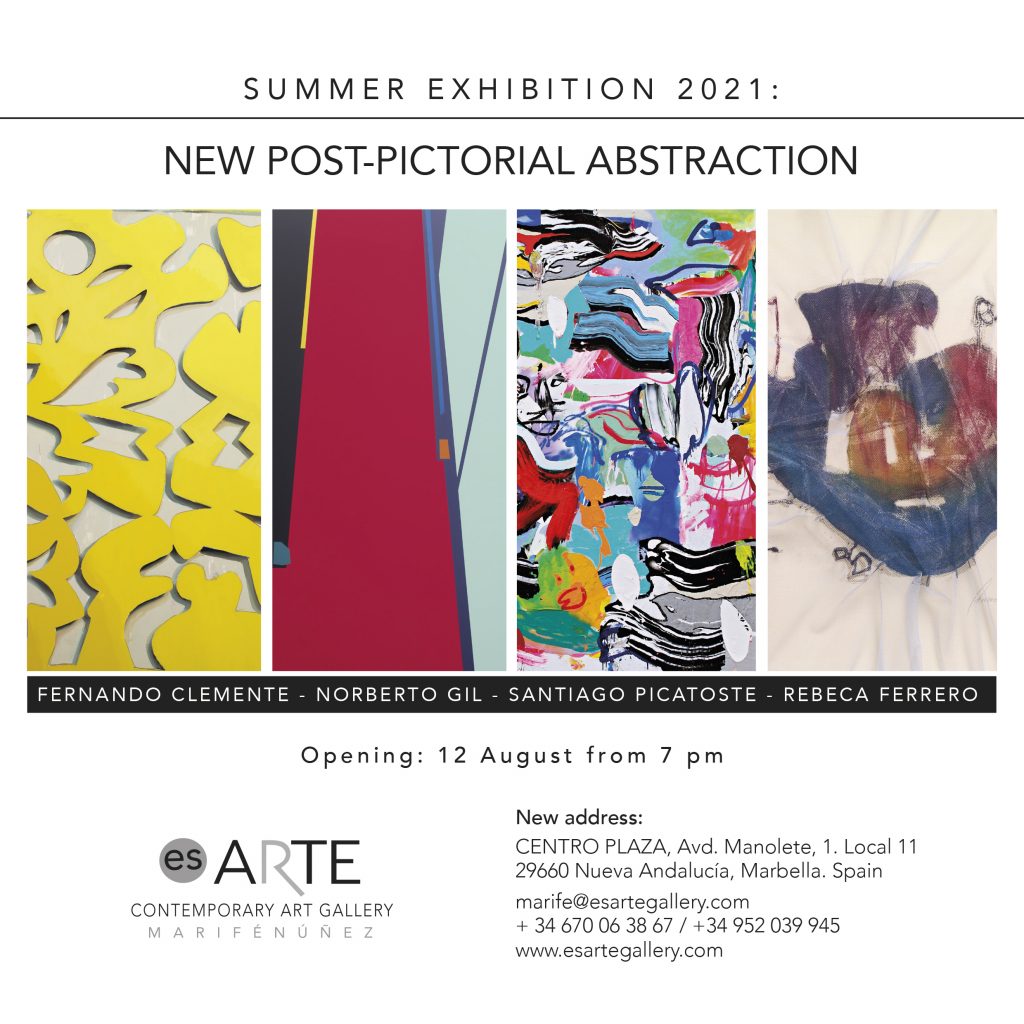
[vc_row][vc_column width=”1/2″][vc_single_image image=”15385″ img_size=”medium” alignment=”center”][vc_empty_space height=”10px”][vc_btn title=”NORBERTO GIL” style=”outline” shape=”square” color=”black” size=”sm” align=”center” button_block=”true” link=”url:https%3A%2F%2Fesartegallery.com%2Fen%2Fnew-post-pictorial-abstraction%2Fnorberto-gil-2|title:Norberto%20Gil|”][/vc_column][vc_column width=”1/2″][vc_single_image image=”15387″ img_size=”medium” alignment=”center”][vc_empty_space height=”10px”][vc_btn title=”REBECA FERRERO” style=”outline” shape=”square” color=”black” size=”sm” align=”center” button_block=”true” link=”url:https%3A%2F%2Fesartegallery.com%2Fen%2Fartists%2Frebeca-ferrero%2Frebeca-ferrero-2|title:Rebeca%20Ferrero|”][/vc_column][/vc_row][vc_row][vc_column width=”1/2″][vc_single_image image=”15383″ img_size=”medium” alignment=”center”][vc_empty_space height=”10px”][vc_btn title=”FERNANDO CLEMENTE” style=”outline” shape=”square” color=”black” size=”sm” align=”center” button_block=”true” link=”url:https%3A%2F%2Fesartegallery.com%2Fen%2Ffernando-clemente|title:Fernando%20Clemente|”][/vc_column][vc_column width=”1/2″][vc_single_image image=”15389″ img_size=”medium” alignment=”center”][vc_empty_space height=”10px”][vc_btn title=”SANTIAGO PICATOSTE” style=”outline” shape=”square” color=”black” size=”sm” align=”center” button_block=”true” link=”url:https%3A%2F%2Fesartegallery.com%2Fen%2Fsantiago-picatoste-3|title:Santiago%20Picatoste|”][/vc_column][vc_column][vc_single_image image=”10956″ img_size=”medium” alignment=”center” title=”Jorge Hernández”][vc_empty_space][vc_btn title=”Jorge Hernández” style=”outline” shape=”square” color=”black” size=”sm” align=”center” link=”url:https%3A%2F%2Fesartegallery.com%2Fen%2Fjorge-hernandez|title:Jorge%20Hern%C3%A1ndez|”][/vc_column][/vc_row][vc_row][vc_column][vc_column_text] NEW POST-PICTORIAL ABSTRACTION Fernando Clemente – Norberto Gil – Santiago Picatoste – Rebeca Ferrero The foundations of the symbol Patricia Bueno del Río Around 1940, Barnett Newman asked himself why paint, possibly because in his time, the conceptual was making its way into a world in which the hegemony of thought was becoming increasingly important. “Everything has a form, and every form has a meaning”, suggested Josef Albers, aware that in creation there was no merit or apocryphalism in exalting colour and matter as the sole reason for its existence when it came to painting. Offering a deconstructed, personal and subjective image of the world seems today to be the most romantic way of creating a plausible image, simply for the value of cementing thought and for the audacity of showing it in a world in which direct messages prevail. This is why the different ways in which artists confront the creation of abstract forms are mysteries that do not attend to methodical reasoning, perhaps because in the action of stripping away the burden – the material and sometimes the conceptual – only the intentionality of the one who creates is left uncovered, that is, the truth of the painter who paints, his sense of aesthetics and his mastery of technique, questions which are not currently praised, but which are true because, in the sack of hedonism, who is unburdened enough to be able to cast the first stone? . In the case of the artists in the exhibition, this way of thinking seems to fit in with their working methodologies, making use of simple abstracted forms that appear combined in personal compositions on spaces that are almost always unreal. This is the case in the work of Fernando Clemente (Jerez de la Frontera, Cádiz, 1975), an artist with an intimate and emotive painting that tends towards a particular abstraction. In his latest stage, Clemente has investigated the physical qualities of pictorial creation, of the object, and has enriched his artistic language with drifts that pursue formal analogies between plastic and musical composition, in which rhythm, colour and line are perceived as equidistant components. His creations are a display of enthusiasm, a feeling difficult to rationalise, which awakens the creative explosion. His geometry situates the spectator, while colour envelops him. But at the same time, he uses masterly resources that endorse him as a painter of method, such as highlights, shadows and overlaps, and denotes the existence of a certain nostalgia for the primitive, for purity. Norberto Gil (Seville, 1975), on the other hand, carries out an abstraction that starts from a pre-established idea. In his works, one can guess forms that refer to architecture or elements of it, through the use of acid colours, studied compositions and a flawless workmanship. Contemplating his creations, one is forced to discern the purification of the forms, which are reduced to their fundamental components: lines, planes and cubes. Structurally, he presents an overwhelming harmony, through his studied previous work of proportion and composition, with which he obtains as a result a painting of great balance between geometry and colour. This is why his works are basically constructive, even though they manage to stimulate the eye, stimulate the memory and stimulate thought. As for the work of Santiago Picatoste (Palma de Mallorca, 1971), it goes without saying how long he has been pursuing his career and highlighting his capacity to evolve, since he is an artist who combines his very strong personality with a constant vocation for research and a great capacity to evolve, which has led him to go through different stages, now finding himself at a moment of synthesis in which he amalgamates his recognised abstract style with a certain reminiscence of the world of Comic strips. Picatoste creates, now as before, keeping in mind the spontaneity and alchemy in the creative process, but his plastic idea becomes more and more expressionist. His latest creations use an innovative and eco-friendly material, polyvinyl acetate, which he uses as a binder for his pigment and which is created from recycled plastics obtained from the oceans. Moreover, his cosmopolitan style, which contrasts with his systematic use of instinctive gesture, connects him to the styles of the 20th century American avant-garde and links him to the premise that links him to his other poster partners, the conceptual reduction to the fundamentals of his work, or as they say in the guild: linking it to the orbit of “painting”. Finally, Rebeca Ferrero (Béjar, Salamanca, 1990), a young artist whose creativity gives her enough coverage to be the fourth bastion of the show. Her work, abstract and innovative, combines her plastic capacity with the risk derived from the personal use of the technique she employs, since, from engraving, she creates genuine compositions based on the superimposition of various treated canvases, resulting in a unique and subjective work, based on the genre of landscape. The resulting scenes are suggestive and attractive; evanescent, which makes the spectator immerse himself in a kind of dreamlike episode that invites him to think and feel. His originality lies not only in the innovative use of technique, but also in the selection of materials – the canvases – which he superimposes, combines and manipulates in order to make the form more concrete, beyond the simple support. A use that recalls, in essence, Louise Bourgeois’ mythical phrase: “Weaving as a way of healing”. In short, a heterogeneous and sublime cast, who make use of semantic ambiguity to project an enigma for the spectator’s gaze, who is challenged and acts between the desire to see and
FIGURATION IN TMES OF TRANSITION
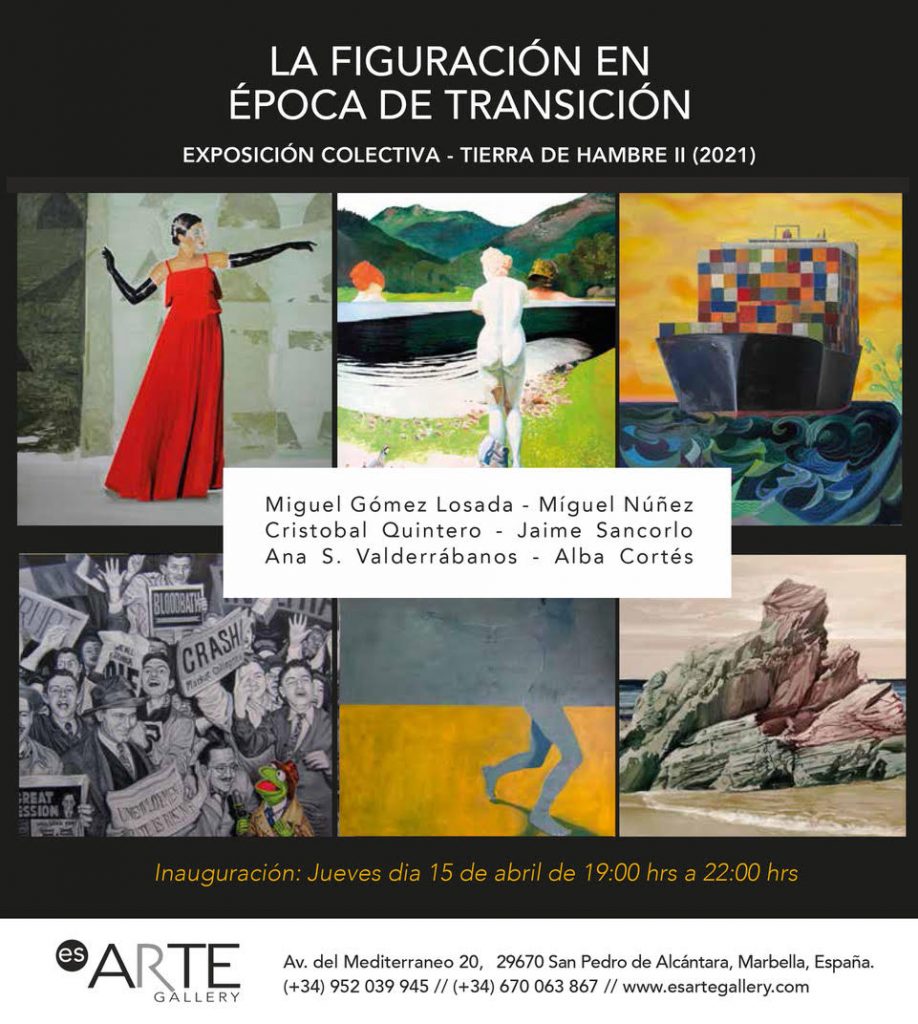
[vc_row][vc_column][vc_column_text] EARTH HUNGER II – FIGURATION IN TIMES OF TRANSITION Es.Arte Gallery, presenta la exposición Tierra de Hambre: La figuración en tiempos de transición, la tercera edición de la colectiva anual que desde 2018 lleva a cabo la galería con un objetivo social: La lucha por la concienciación. (Tierra de Hambre y Be woman & Smile). La propuesta, resultado de una convocatoria previa, apuesta por vincular la plástica al mensaje y cuenta con la participación de seis artistas, con cuya obra se llevará a cabo un acercamiento al pensamiento actual. En esta ocasión, y dada la calidad de las propuestas, la exposición Tierra de hambre se dividirá en dos etapas, la primera de ellas, con subtitulo La figuración en tiempos de transición, que se inaugura el 15 de abril, y La abstracción en tiempos de transición, pendiente de definir fecha.[/vc_column_text][vc_empty_space][/vc_column][/vc_row][vc_row][vc_column width=”1/3″][vc_single_image image=”14050″ img_size=”medium” alignment=”center”][vc_btn title=”MIGUEL GÓMEZ LOSADA” shape=”square” size=”sm” align=”center” button_block=”true” link=”url:https%3A%2F%2Fesartegallery.com%2Fen%2Fartists%2Fmiguel-gomez-losada|title:Miguel%20G%C3%B3mez%20Losada|target:%20_blank|”][/vc_column][vc_column width=”1/3″][vc_single_image image=”14052″ img_size=”medium” alignment=”center”][vc_btn title=”MIGUEL NÚÑEZ” shape=”square” size=”sm” align=”center” button_block=”true” link=”url:https%3A%2F%2Fesartegallery.com%2Fen%2Fartists%2Fmiguel-nunez|title:Miguel%20N%C3%BA%C3%B1ez|target:%20_blank|”][/vc_column][vc_column width=”1/3″][vc_single_image image=”14054″ img_size=”medium” alignment=”center”][vc_btn title=”CRISTÓBAL QUINTERO” shape=”square” size=”sm” align=”center” button_block=”true”][/vc_column][/vc_row][vc_row][vc_column width=”1/3″][vc_single_image image=”14056″ img_size=”medium” alignment=”center”][vc_btn title=”ALBA CORTÉS” shape=”square” size=”sm” align=”center” button_block=”true” link=”url:https%3A%2F%2Fesartegallery.com%2Fen%2Fartists%2Falba-cortes|title:Alba%20Cort%C3%A9s|target:%20_blank|”][/vc_column][vc_column width=”1/3″][vc_single_image image=”14058″ img_size=”medium” alignment=”center”][vc_btn title=”JAIME SANCORLO” shape=”square” size=”sm” align=”center” button_block=”true” link=”url:https%3A%2F%2Fesartegallery.com%2Fen%2Fartists%2Fjaime-sancorlo|title:Jaime%20Sancorlo|target:%20_blank|”][/vc_column][vc_column width=”1/3″][vc_single_image image=”13996″ img_size=”medium” alignment=”center”][vc_btn title=”ANA VALDERRÁBANOS” shape=”square” size=”sm” align=”center” button_block=”true” link=”url:https%3A%2F%2Fesartegallery.com%2Fen%2Fana-sanchez-valderrabanos|title:Ana%20S%C3%A1nchez%20Valderr%C3%A1banos|target:%20_blank|”][/vc_column][/vc_row][vc_row][vc_column][vc_column_text][/vc_column_text][vc_empty_space][vc_column_text] THE BEAUTY SEEKERS CRITICAL TEXT: Patricia Bueno del Río In the last year, humanity has been forced to question the hegemonic narratives that envelop the complexity that is ascribed to a process of transition such as the one we are going through. It is therefore necessary to reflect on the strategies of others with a certain resistance and contestation, something that art has always pursued: critical thought and aesthetic reflection in order to provide answers. In the nature of a process of change, there is a trigger that paralyses, and therefore causes a gradual temporary deactivation of artistic practices. On becoming aware of this, activity is reactivated and creative thought is renewed, often disrupted by the new reality that occurs. The authors that this exhibition brings together are, in a way, seekers of the answer through beauty; contrary, in a way, to Danto’s dogma that considered beauty as a backward vision of art. In the work of each of the authors, there is metaphysics, introspective value and external panorama, but without a doubt, the different perspectives they offer are close to the Kantian philosophy that defines beauty as the free play of the human faculties, of sensitivity and understanding. Miguel Losada and Miguel Núñez do so from an exquisite poetics with which they reflect an affective way of recreating the image. The former, representing the exaltation of the graceful through the posture, the bearing and the pomp with which he endows the human figures he represents; the latter, transfiguring spaces in which the presence of the human being is reduced to the majestic reproduction of the same through sculpture. Cristóbal Quintero, with irony, through scenes full of symbolic charge in which plastic art and language are linked to achieve a symbolic image full of strength, humour and meaning. Alba Cortés, for her part, approaches beauty with the emphatic representation of a mountainous landscape which she endows with subtle nuances, appealing to the sublime from a point of view that is very similar to Romanticism; Ana S. Valderrábanos, from the reduction of the image to planes of a soft monochrome that gives light to the representation of sweet and optimistic scenes of childhood, and Jaime Sancorlo, with a work full of content, which invites us to focus on the minuteness of the details, and a marked irony that connects head-on with the viewer. In this way, the message of each creator is ascribed to his language, and even underlies his particular way of understanding the world, assuming its changes and adapting to them. This is what prevails: the search for truth and its implicit way of conceptualising through subjective vision. Aesthetics is inevitably useful for being contentious. The beautiful is now necessarily free and disinterested, therefore richer, more necessary and transcendental.[/vc_column_text][vc_empty_space][vc_media_grid grid_id=”vc_gid:1619269694768-3c955f96-ad70-4″ include=”14238,14240,14242,14246,14250,14252,14254,14258,14266″][/vc_column][/vc_row]
Collective Exhibition Summer 2020: Parallel Times

[vc_row][vc_column width=”1/3″][vc_single_image image=”10978″ img_size=”full” onclick=”custom_link” img_link_target=”_blank” link=”https://esartegallery.com/salustiano”][vc_btn title=”SALUSTIANO” style=”outline” shape=”square” color=”black” size=”xs” align=”center” button_block=”true” link=”url:https%3A%2F%2Fesartegallery.com%2Fen%2Fsalustiano|title:Salustiano|”][/vc_column][vc_column width=”1/3″][vc_single_image image=”10782″ img_size=”full” alignment=”center” onclick=”custom_link” img_link_target=”_blank” link=”https://esartegallery.com/artistas/santiago-picatoste”][vc_btn title=”SANTIAGO PICATOSTE” style=”outline” shape=”square” color=”black” size=”xs” align=”center” button_block=”true” link=”url:https%3A%2F%2Fesartegallery.com%2Fen%2Fartists%2F8591-2|title:Santiago%20Picatoste|”][/vc_column][vc_column width=”1/3″][vc_single_image image=”10980″ img_size=”full” alignment=”right” onclick=”custom_link” img_link_target=”_blank” link=”https://esartegallery.com/jorge-hernandez”][vc_btn title=”JORGE HERNÁNDEZ” style=”outline” shape=”square” color=”black” size=”xs” align=”center” button_block=”true” link=”url:https%3A%2F%2Fesartegallery.com%2Fen%2Fjorge-hernandez|title:Jorge%20Hern%C3%A1ndez|”][/vc_column][/vc_row][vc_row][vc_column][vc_column_text][/vc_column_text][vc_empty_space][vc_column_text] PARALLEL TIMES 14/08/ to 30/09/2020 JORGE HERNÁNDEZ – SANTIAGO PICATOSTE – SALUSTIANO Tres tipos raros y la pintura (Texto Crítico Andrés Isaac Santana) Con todo y el fervor desmedido de sus sepultureros de turno, la pintura sigue viva, se pavonea despampanante y alegre allí mismo donde el resentimiento de cierto conceptualismo se aventura a decretar su muerte una y otra vez. La redención, lo sabemos, no es más que una ilusión concertada, una mentira en boca de esos que buscan la salvación de la muerte expiando sus pecados y sus culpas. Pero aquí no. En este espacio insoldable, en este ámbito de malabares y de intenciones cifrado bajo el nombre de Es Arte Gallery, la redención es, si acaso, auténtica caricatura. Aquí no vale hablar de culpas ni de pesares; aquí vale, y mucho, reconocer el descaro de tres grades pecadores, la vehemencia de tres tipos raros que, a contracorriente del carnaval de las defunciones, saben gozar la pintura haciendo de ella el centro de su ritual erótico. Instantes paralelos, por tanto, no es una exposición cualquiera; es, con mucho, una suerte de celebración del estado de salud de un género que, mientras existan pintores como Jorge Hernández, Santiago Picatoste y Salustiano, resultará imposible pensar en cualquier tipo de deterioro o de ocaso relamido y triste. Su título, literal y metafórico, no deja de parecerme atractivo. Sin embargo, por deformación crítica la mía que todo lo cuestiona, se me antoja un tato contradictorio al tiempo mismo que eficaz y provocador. Por paralelo se entiende aquello que jamás podrá cortar otra línea u otro plano por más que se prolongue en el espacio y en el tiempo, dado que todos los puntos de uno están a la misma distancia del otro. Tanto es así que “las caras opuestas del cubo son paralelas entre sí”, una y otra permanecerán, eternamente, a la misma distancia. Sabido esto, aflora entonces una contradicción de plano toda vez que, si bien las gramáticas pictóricas de estos artistas españoles, se orquesta bajo el signo de un mundo referencial autónomo; cierto es, también, que ellos sí que se cruzan en un plano y en una línea común: la de la confesión que implica el reconocimiento de su amor y de su adicción por la ductilidad y espesura de la materia pictórica. Los tres, a su modo, ejercitan un particular instinto de conservación de ella y un gusto por la tragedia, en el sentido de amarla más allá de su presunta muerte y de su excitación recurrente. Sus distancias, insisto en esta idea, se acercan en la pasión con la que los tres asumen el soporte y el cuerpo de la pintura para convertirlo en un espacio proclive al desvío retórico y a la vocación narrativa de la misma. Esta muestra, curada por Marifé Nuñez, también artista y -a diferencia de ellos- mujer, se traduce así en un inteligente y noble ejercicio de afirmación. Pero no de una afirmación narcisista que rinde culto a la pintura como una suerte de nuevo dios entre los lenguajes del arte. Bien sabemos que todo dios es una segregación, una deformación, una contracción a la que resulta caro el abandono, la soledad y la muerte antes o después de las epifanías y del fervor que nace de la oscuridad y de la sumisión. La afirmación se da y ocurre como consecuencia directa de esa voluntad y de esa necesidad de seguir creyendo en el valor y en la capacidad del lenguaje pictórico para crear, para fundar, para narrar mundos autónomos más allá de las circunstancias y de las modas. Estos tres artistas, examinados ahora desde el prisma y la versatilidad inmanente a la mirada femenina, revelan su poderío en el campo de la pintura haciendo gala no sólo de su competencia en el oficio; sino también de su capacidad y dinamismo en el proceso de asignar nuevos y frondosos sentidos al discurso (y al decir) de la pintura. La Real Academia de la Lengua se apresura a nombrar la cualidad de lo dúctil como “la capacidad para conducir el calor o la electricidad, la dureza, la maleabilidad o la ductilidad son cualidades específicas de ciertos materiales”, precisa. Y es esta misma capacidad, esa misma cualidad, la que conecta el trabajo de estos artistas y justifica la digresión enfática de su curadora al convocarlos en el mismo tiempo y en el mismo espacio: el instante paralelo. Resulta desde todo punto de vista tentador el hecho de que esta mezcla de nombres y de obras, termine por configurar un campo axiológico en sí mismo en el que podemos advertir tres de los horizontes o líneas de actuación de la pintura contemporánea. Ellos son: el sentido narrativo de la visitación y de la cita solapada (Jorge Hernández), la permanencia revulsiva y audaz de la abstracción junto a su cualidad de significación (Santiago Picatoste) y, por último, la recurrencia al retrato en su propio campo expandido y en su densidad alegórica (Salustiano). Tres líneas o ámbitos de sentido que dispensan infinitas provocaciones e interpelaciones al discurso de la crítica y a sus posibilidades de organización en torno al mismo. Líneas que, valga decir, no implican militancia temporal alguna ni la rubricación de un principio jerárquico y disyuntor. Las tres propuestas, en sus notables diferencias y en sus presuntas cercanías, no hacen sino señalar la versatilidad de la pintura y el alcance de la narrativa pictórica contemporánea evidenciando, entre otras cosas, que el debate acerca de su muerte se reduce a una cuestión de perspectiva, de ideología y de intereses más o menos previsibles. Un debate que, por sí solo, asiste a la desaparición de sus motivos y al deterioro de sus razones argumentales. Basta observar la obra de estos
On the Road (Sergio Padilla) Junio 2020

[vc_row][vc_column][vc_single_image image=”10447″ img_size=”full”][vc_empty_space height=”20px”][vc_column_text] EXHIBITION JUNE / JULY “ON THE ROAD” WE INVITE YOU TO TAKE A WALK THROUGH OUR VIRTUAL TOUR Sergio Padilla – Pedro Rodríguez – Santiago Picatoste – Jorge Hernández – Paco Sanguíno – Angela Lergo [/vc_column_text][vc_empty_space height=”20px”][vc_column_text][/vc_column_text][vc_empty_space height=”20px”][/vc_column][/vc_row]
Group Exhibition – Without Smiles There Is No Paradise
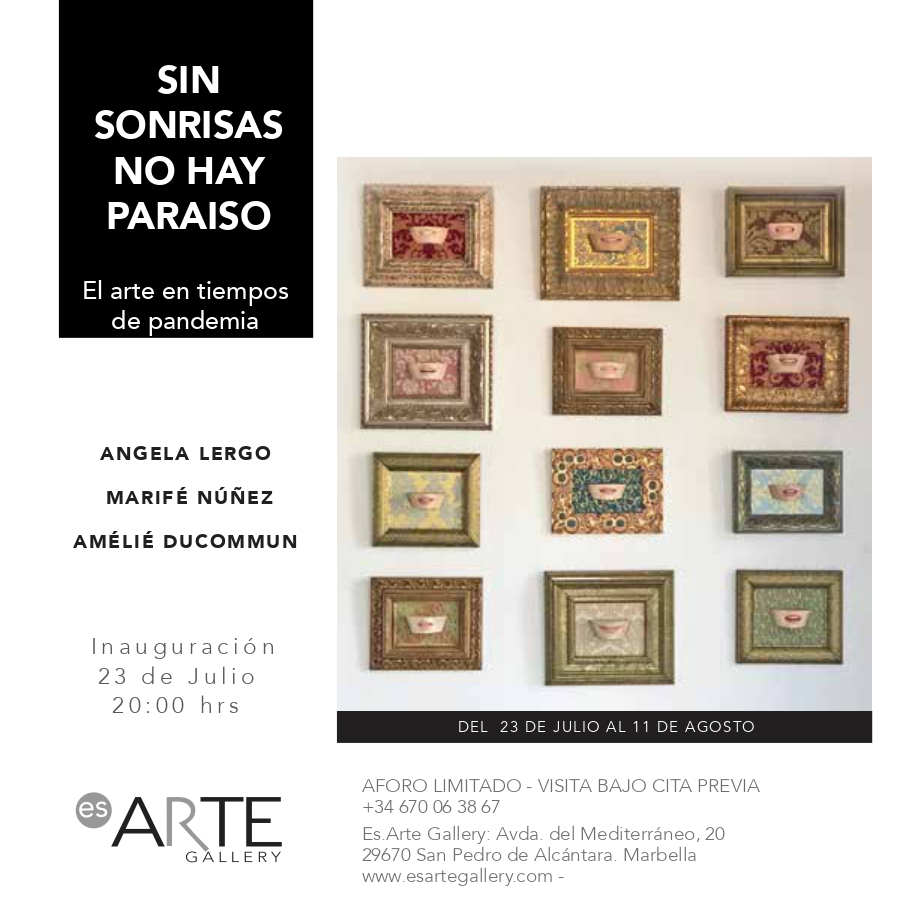
[vc_row][vc_column][vc_single_image image=”10602″ img_size=”full” alignment=”center”][vc_empty_space][vc_column_text] WITHOUT SMILES THERE IS NO PARADISE Art in a pandemic time ANGELA LERGO – MARIFÉ NÚÑEZ – AMÉLIÉ DUCOMMUM Desde el 23 de Julio – al 11 de Agosto Es.arte gallery, presents the Exhibition entitled “Without smiles there is no paradise” framed in a pandemic period COVID19. Three women committed in this context, make an analysis and a social criticism about the moment we are living. Angela Lergo presents us her series “The sunshine of your smile”. A sculptural installation of timeless smiles that take on a contemporary nature, converted into a vindicating manifestation of the most authentic human expression, that expression that elevates our soul and connects with our heart and that now hides under a mask; THE SUNSHINE. Marifé Núñez, however, emphasizes the eyes with “the all-seeing eye” that transcends beyond the work and with a critical and defiant LOOK, that makes the observer question the becoming of the world. Amélié Ducommum, shows us the essence that exists around us covered by a white veil that subtly reveals the wonder of color and the force of life. An exhibition that will certainly not leave you indifferent. [/vc_column_text][vc_empty_space][vc_media_grid grid_id=”vc_gid:1595591065523-297ad521-33ff-2″ include=”10641,10723,10637,10677,10691,10687,10643,10663,10655,10653,10683,10731,10719,10661,10645,10671,10673,10657,10647,10675,10669,10651,10725,10735,10721,10635,10659,10667,10649,10639,10685,10695,10693,10705,10689,10697,10699,10701,10703,10711,10713,10717,10729,10727,10733,10737,10756,10760,10762,10754,10764,10746,10744,10748,10750,10752,10758,10766″][vc_empty_space][/vc_column][/vc_row]
Group Christmas Exhibition – Art on Paper and Cardboard

[vc_row][vc_column][vc_single_image image=”8443″ img_size=”full” alignment=”center”][/vc_column][/vc_row][vc_row][vc_column][vc_message]Exhibition: Group Christmas Exhibition – Art on Paper and Cardboard Date: To be confirmed Place: Es Arte Gallery, Avenida del Mediterráneo 20, 29670 San Pedro de Alcántara[/vc_message][/vc_column][/vc_row][vc_row][vc_column][vc_column_text]Es Arte Gallery is pleased to present its New Group Christmas Exhibition “Art on Paper and Cardboard”. This Christmas we have made a selection of works on paper and cardboard that includes: Photographs, watercolors, monotypes, serigraphs, engravings and limited editions of recognized national and international artists. Come and enjoy this exclusive art exhibition in Marbella any day from Monday to Friday from 10:300 to 14:00 and from 17:30 to 20:30. If you want to request a private visit after hours call us at (+34) 670 063 867. You can see our exhibitions at Es arte gallery in Avenida del Mediterráneo 20, 29670 San Pedro de Alcántara, Marbella, Spain and at the Magna Café gallery which is located at Avda Calderón, 29660 Nueva Andalucía.[/vc_column_text][/vc_column][/vc_row][vc_row][vc_column][vc_media_grid grid_id=”vc_gid:1590779595634-49ad970e-dca5-2″ include=”8521,8495,8511,8474,8476,8489,8497″][/vc_column][/vc_row]
Group Exhibition – Figurative Metamorphosis
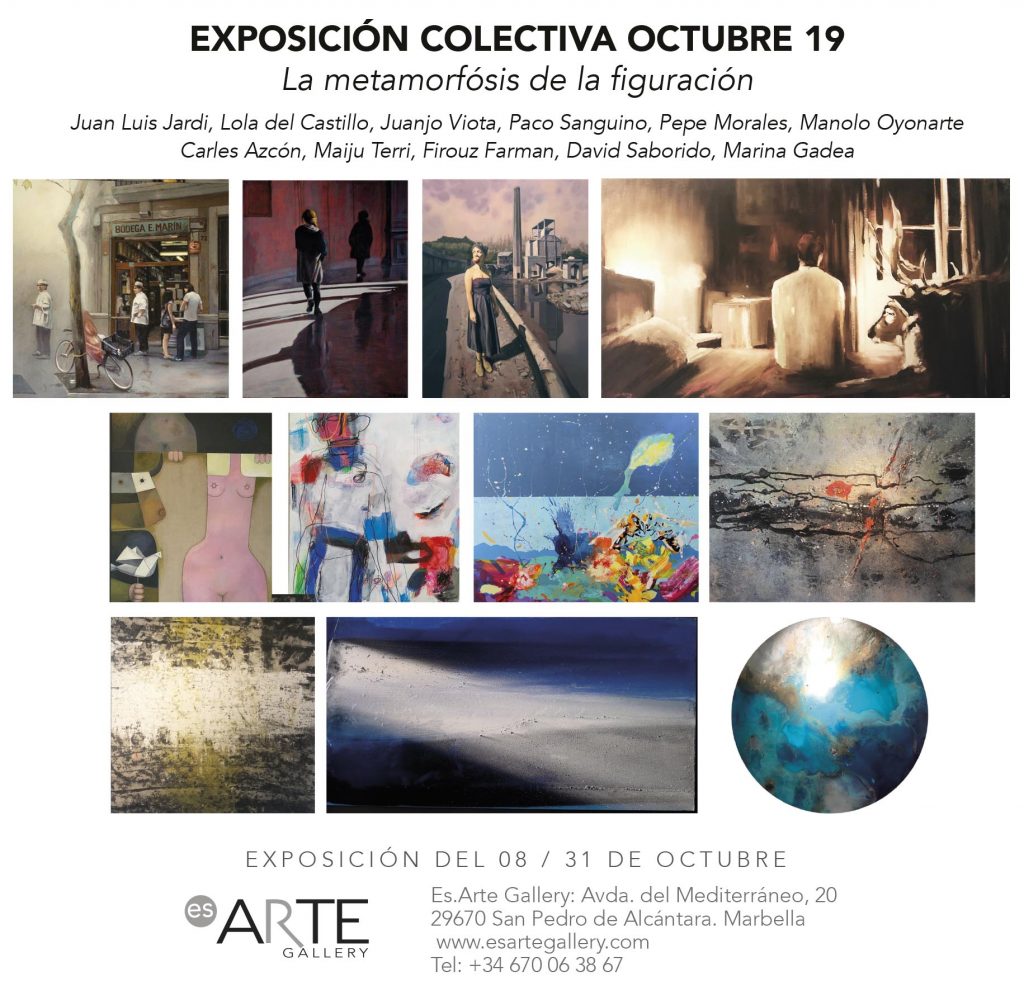
[vc_row][vc_column][vc_column_text][/vc_column_text][vc_single_image image=”7052″ img_size=”full” alignment=”center” onclick=”link_image”][vc_message]Exhibition: Figurative Metamorphosis Date: From October 22 to October 31, 2019. Place: Art Gallery Marbella.[/vc_message][vc_column_text] Es Arte Gallery is pleased to present its new group exhibition Figurative Metamorphosis, from Tuesday October 22 until Thursday 31. We bring figurative contemporary artists who, in whose fading of the sharpness of the forms, seek to derive expressionism, ending in abstraction. Juan Luis Jardi, Lola del Castillo, Juanjo Viota, Paco Sanguino, Pepe Morales, Manolo Oyonarte, Carles Azcón, Maiju Terri, Firouz Farman, David Saborido, Marina Gadea Come and enjoy this exclusive art show in Marbella any day from Monday to Friday from 10:00 a.m. to 2:30 p.m. and from 5:30 p.m. to 8:30 p.m. If you want to request a private visit after hours call us at (+34) 670 063 867. We are waiting for you at Avenida del Mediterráneo 20, 29670 San Pedro de Alcántara, Marbella, Spain. [/vc_column_text][/vc_column][/vc_row][vc_row][vc_column][vc_media_grid element_width=”3″ grid_id=”vc_gid:1571845893222-caf2fbaf-200c-8″ include=”7027,7025,7029,7033,7037,7041,7045,7043″][/vc_column][/vc_row]
Group Exhibition May 2019

[vc_row][vc_column][vc_single_image image=”8262″ img_size=”full” alignment=”center” onclick=”link_image”][/vc_column][/vc_row][vc_row][vc_column][vc_message]Exhibition: Group Exhibition May 2019. Date: From 02 of May to 28 of May 2019. Place: Es.Arte Gallery Marbella.[/vc_message][/vc_column][/vc_row][vc_row][vc_column][vc_column_text]During this month of May Es.Arte Gallery exhibits works of artists like Laura Iniesta, Irene Baón, Carles Ascón, Javier Martín, Cristina Guerreo, Aurora Cid, Damla Ozdemir, Eva Ohlow and Agustín de la Cruz. Come and enjoy this exclusive art show in Marbella any day from Tuesday to Friday from 10:30 to 13:30 and from 17:30 to 19:30. If you would like to request a private visit outside of these hours, please call us at (+34) 670 063 867. We are waiting for you at Avenida del Mediterráneo 20, 29670 San Pedro de Alcántara, Marbella, Spain.[/vc_column_text][/vc_column][/vc_row]
Event: closure of Johan Wahlstrom and presentation of Alejandro Dron
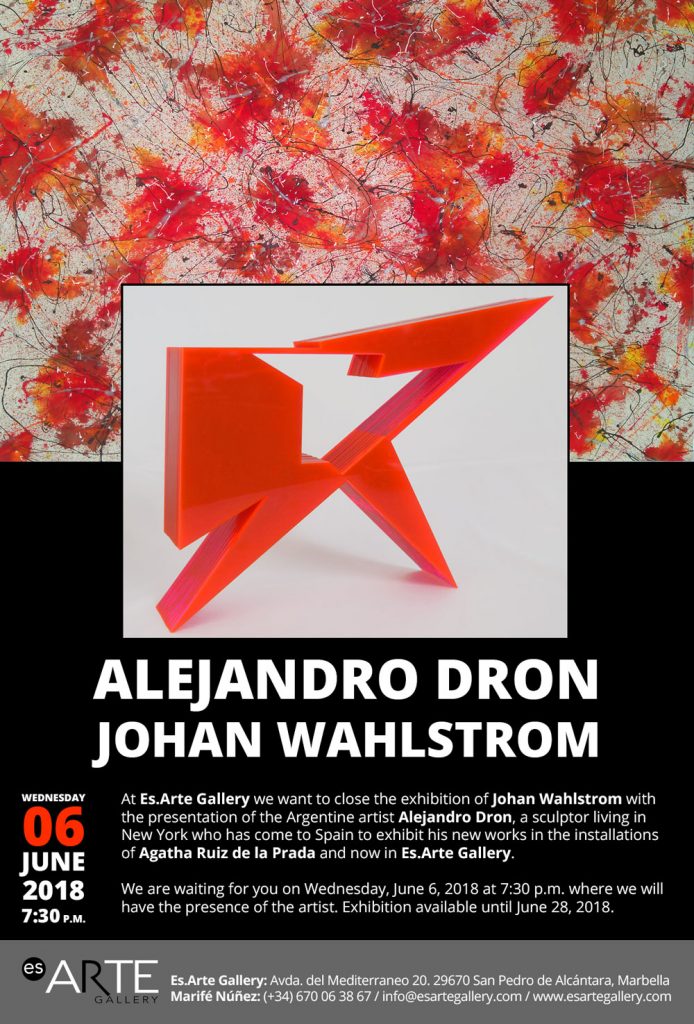
[vc_row][vc_column][vc_single_image image=”3749″ img_size=”full” alignment=”center” onclick=”link_image”][/vc_column][/vc_row][vc_row][vc_column][vc_message]Presentation with the artist: Wednesday June 6, 2018, from 7:30 p.m. to 10 p.m. Exhibition: From 06th to 28th of June 2018. Place: Es.Arte Gallery. Avda. del Mediterráneo 20. 29670 San Pedro de Alcántara, Marbella, Spain.[/vc_message][/vc_column][/vc_row][vc_row][vc_column][vc_column_text]At Es.Arte Gallery we want to closure the exhibition of Johan Wahlstrom with the presentation of the Argentine artist Alejandro Dron, a sculptor living in New York who has come to Spain to exhibit his new works in the installations of Agatha Ruiz de la Prada and now in Es.Arte Gallery. We are waiting for you on Wednesday, June 6, 2018 at 7:30 p.m. where we will have the presence of the artist. Exhibition available until June 28, 2018. Do not miss the opportunity to contemplate and acquire the art by Johan Wahlstrom! About Alejandro Dron: Alejandro Dron was born in La Plata, Argentina, in 1962. He currently lives in the United States where he continues working on his art. His acclaimed sculptures have been exhibited in several galleries and museums around the world, such as the Museo Reina Sofía in Madrid (Spain), the Centro Cultural Recoleta in Buenos Aires (Argentina) or in Mana Contemporary (United States). His multi-directional and multi-dimensional works are eccentric. They don’t present fixed positions. They are created so that they open like a book and understand all their transformations. Thanks to his work, Alejandro Dron was named Best Sculptor of the year in the Hudson Valley, has been nominated for Rokefeller Grant in New Media, and has been published in many art magazines and newspapers, including the New York Times.[/vc_column_text][/vc_column][/vc_row][vc_row][vc_column][vc_btn title=”Read more about Alejandro Dron” style=”outline” shape=”square” color=”black” size=”lg” align=”center” link=”url:https%3A%2F%2Fesartegallery.com%2Fen%2Fartists%2Falejandro-dron||” button_block=”true”][/vc_column][/vc_row]